Eradicating the Cult of the Operational Hero: How Tribal Knowledge Sabotages Mid-Market Scalability
A deep exposure of memory-dependent workflows, process fragmentation, and why relying on individual human unicorns traps family-owned businesses in a structural cage.
The Diagnostic Capsule: Many mid-market businesses pride themselves on having an agile, dedicated team capable of staging last-minute saves to get customer orders out the door. This reliance on individual performance represents a severe structural architecture flaw. You cannot scale human heroism. When your operations live inside your employees’ heads rather than inside your company’s intellectual property, your corporate asset value is essentially zero. This paper outlines the operational physics of tribal knowledge, breaks down the danger of the “Sales Hero,” and introduces the Four Laws of Business Architecture required to build an autonomous system.
The most expensive word on a warehouse floor or a logistics dispatch line is “Usually.”
When checking a manual backend process, ask your ground-level team a simple question: “How do you verify and input a non-standard custom order layout?” If the response begins with, “Well, usually we do this…” you have a structural problem.
“Usually” is the symptom of an unarchitected business. It means your core transaction workflows exist as fluid, unwritten habits rather than permanent programmatic guidelines. The ground-level operations are completely dependent on your old staff remembering what to do based on years of tribal exposure.
If your processes are not documented, they do not exist as corporate assets. You are simply running an ongoing series of guesses. This lack of structure forces you, the owner, to work 60 hours a week fighting fires, because you are the only centralized hub who knows how to handle the manual exceptions. You haven’t built a scalable distribution business; you have simply built yourself a high-stress management job.
This heavy reliance on human memory is equally destructive to your front-end revenue pipeline. Most mid-market B2B companies do not own a scalable sales process. They own “Sales Heroes.”
You hire a charismatic individual, hand them a phone, and hope for a spike in client volume. When they land a massive logistics or wholesale contract, the company celebrates. But from a systems engineering perspective, this layout is incredibly fragile.
When your revenue generation depends on a single person’s charm and individual memory, you are running a personality cult, not a business. The moment that individual exits the firm to join a competitor, your customer data, relationship history, and pipeline volume leave with them.
A business architect ignores surface-level charm and fixes the underlying data handoffs. We build a deterministic framework: Is your lead qualification stage tied to specific criteria? Is the order data passed to the warehouse via an automated middleware trigger or a chaotic manual email? If your pipeline relies on finding perfect human unicorns to survive, it will never scale predictably.
The true failure of an analog operational foundation becomes clear during a sudden personnel transition. Imagine your veteran warehouse operations manager walks into your office tomorrow and resigns. Immediately, executive panic sets in.
This panic is proof of a compromised infrastructure.
Your manager wasn’t just directing floor staff; they were a walking, talking encyclopedia of undocumented system bypasses. They were the only person who knew:
- Which suppliers always ship late and require manual margin adjustments.
- The specific handling quirks required for your top three VIP accounts.
- The offline workarounds used to keep your legacy, unintegrated software screens from freezing up.
When that person walks out the door, your entire corporate operational intelligence walks out with them. New hires take months to become marginally productive because there is no system manual to guide them. You are forced to throw more expensive headcount at the chaos just to stabilize your daily picking queues. You have allowed your enterprise infrastructure to become a hostage situation.
To transition your back office from a reactive loop into a resilient system, your architecture must strictly conform to four universal design rules.
If a back-office process requires a human to manually “remember” to execute it, the architecture is broken. System actions must be permanently triggered by data state changes or automated time blocks—never by human memory.
A single data point cannot exist in two different locations simultaneously. If your customer CRM holds one billing profile and your operational fulfillment spreadsheet tracks another, both data sets are corrupted. A scalable enterprise requires one undisputed data record.
A clean systems architecture must be mathematically capable of processing a 10x explosion in transaction volume without requiring a corresponding 10x increase in staff headcount. If your only response to business growth is hiring more clerical bodies, you are simply building a larger, more expensive cage.
Technology is an explicit multiplier of an already clean process blueprint; it is never a rescue mission for a messy one. A programmatic tool or custom automation script cannot fix a broken buyer journey or a disjointed warehouse handoff.
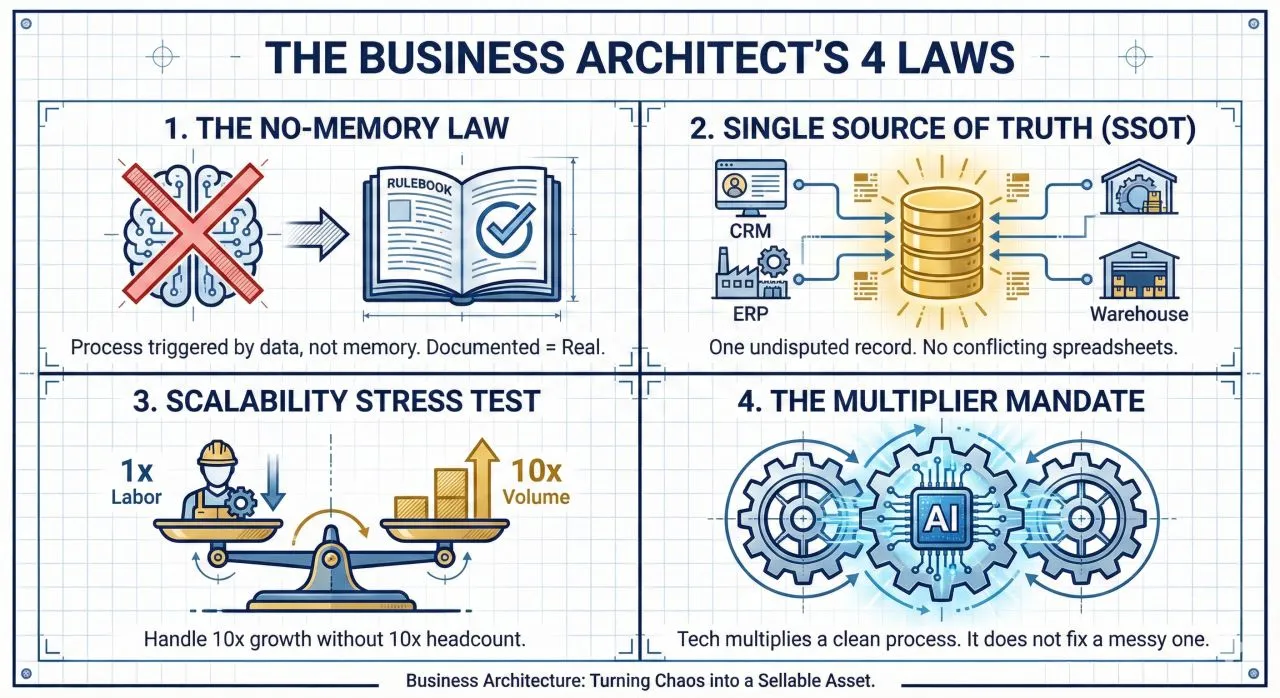
The 4 Laws of Business Architecture: Structural rules for transforming manual operational chaos into an automated, sellable enterprise asset.
Boring operations scale. Exciting, chaotic, last-minute saves do not. If your daily warehouse management feels like an ongoing series of heroic interventions, your business logic is broken.
Stop playing the business hero and start engineering a business machine. Strip out the custom exceptions, extract the tracking rules from your staff’s heads, and embed them directly into systemized workflows. Only when you replace human memory with automated data architecture do you move off the operational treadmill and build a true corporate asset.